When cyber risk turns physical: findings from the AXA XL, DeNexus and Deloitte OT report

On this page
Cyber incidents in industrial companies no longer stop at the network. They stop production lines, delay shipments and, in the worst cases, cause physical damage. A new report from AXA XL, produced with DeNexus™ and Deloitte, sets out what has changed and what industrial companies should do about it.
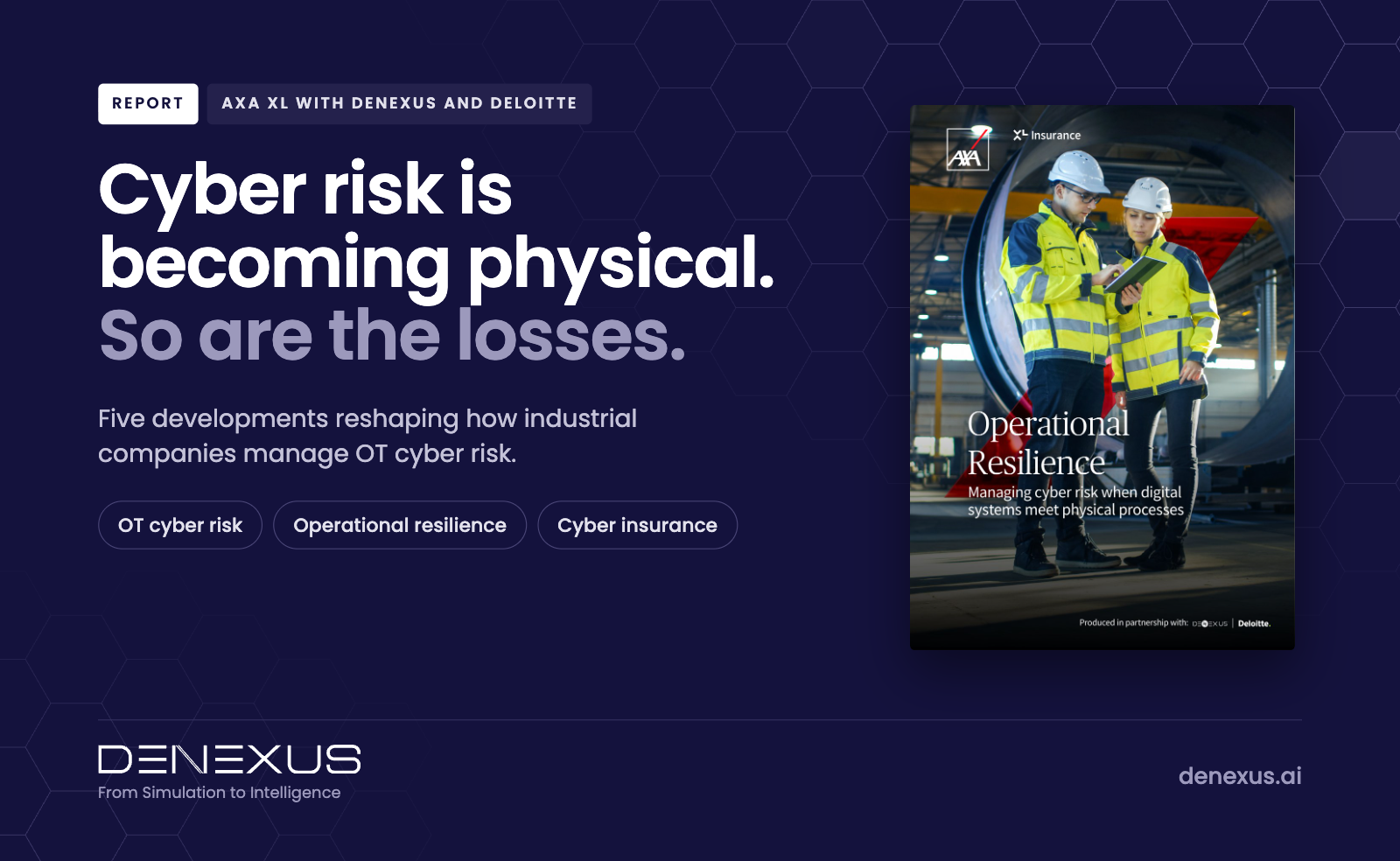
The report is called Operational Resilience: Managing Cyber Risk When Digital Systems Meet Physical Processes. Click the button below to download the full report.

Five developments reshaping OT cyber risk
- Cyber risks are becoming physical. Disruption, or even a suspected compromise, can be enough to halt production.
- OT resilience depends on operational context. Teams need to see vulnerabilities and dependencies, and have recovery plans that protect production and safety.
- Connectivity extends the path to disruption. More links to connected systems and outside suppliers improve efficiency but add exposure.
- OT changes the cyber risk calculation. Security measures built for IT cannot always be applied the same way in operational technology (OT).
- Consequences extend well beyond cyber. Disruption can spread past the factory floor into supply chains, and can cause physical or environmental harm.
Uncertainty alone can stop operations
The report shows that an attack does not need to touch machinery to halt production. In one case, a cyber incident stopped a major manufacturer across several sites through its connected IT systems, and the disruption reached its supply-chain partners. In another, a ransomware attack on a corporate network restricted operations while the company worked out whether OT was affected.
The loss is financial, not just technical
Once an incident crosses from IT into physical operations, the costs change. Lost output, missed deliveries, contract penalties and recovery work can quickly outweigh the cost of the cyber response itself.
“OT scenarios are different because the potential consequences extend beyond data or system availability. An attack may indirectly disrupt operations, deliberately target OT using relatively crude methods, or use sophisticated OT-specific techniques to manipulate control, suppress alarms or disable safety functions. As that targeting becomes more specialised, the potential consequences increase too, from outages and damaged equipment to environmental harm, fire, injury or other serious cyber-physical impacts.”
— Donovan Tindill, OT Cyber Senior Director, DeNexus
Exposure also depends on the site. The same technology can carry very different risk depending on what the plant produces, how much revenue depends on it, and what is being handled.
“Two sites using similar technology can still face very different financial exposure. The scale of loss depends on factors such as production capacity, revenue, the nature of the physical process and what is being handled. Pressure, toxicity, combustion, movement, nearby populations or sensitive environments can all multiply the impact of an incident, as can the cost of business interruption, clean-up, regulatory action and liability following physical damage or harm.”
— Jose Seara, Founder & CEO, DeNexus
What the report recommends
- Start with the operation, not the device list. Identify which processes matter most, how long each can be down before the consequences become serious, and what each one depends on, from suppliers to cloud platforms and utilities. Build an inventory that shows what each critical asset supports, who can access it, and what it would take to restore it safely.
- Treat segmentation as a baseline. Connections between IT, OT and third parties should be deliberate, controlled and monitored. Supplier access should be limited to the systems and time the work needs, protected with strong authentication, and removed when it is done.
- Plan decisions before the incident. Define who can isolate equipment, stop production and approve a safe restart. Test both the technical response and the operational consequences, and protect what recovery depends on: configuration files, controller logic and engineering records.
- Put the risk in financial terms. The report notes that putting financial values against OT scenarios gives a stronger basis for prioritizing investment, especially where legacy equipment cannot be quickly patched or replaced. The same view helps a business decide which losses to reduce, which to retain, and where insurance can help.
That last step is where DeNexus works. The DeRISK™ Intelligence Platform helps industrial operators, insurers and investors quantify, reduce and transfer OT cyber-physical risk.
Download the full AXA XL report, or talk to DeNexus about quantifying your OT cyber risk.
DeNexus and DeRISK are trademarks of DeNexus, Inc.