For underwriters

Assess an OT submission in minutes, not days.

From 10–30 hours of manual work to 10–20 minutes, by DeNexus’s estimate, and you review every output.

Your first submission runs free on DeRISK™ UWA Standard: one document, read as it arrived. It asks the applicant nothing, and a human reviews every output.

Most underwriters price OT risk they cannot see.

Augment your underwriting team with OT cyber specialist capability — without hiring one.

  1. Stated isn’t verified.In one OT survey, 28% said their OT was fully isolated from IT, yet 57% said servers could be controlled from the business network.(CS)²AI, OT Cybersecurity Technology Report 2024
  2. OT risk gets covered, not judged.Cyber questionnaires were written for IT, so a strong OT program and a weak one can look the same on paper. OT losses “have made it difficult for insurers to determine appropriate premiums.”WTW, 2022
  3. OT skills are scarce.A third of EU organizations named OT and ICS security among the cybersecurity skills they most need.ENISA, NIS Investments 2025
10–30 hours
DeNexus estimates a complex OT submission takes 10–30 hours of manual work, mostly spent extracting data rather than deciding.DeNexus estimate

From a form answer to a decision.

One answer, as the applicant gave it, as the assessment reads it, and as you decide on it.

1In the submission

Q41: Is the OT network segmented from IT? “Yes.”

2In the assessment

Stated, not verified: it doesn’t say whether that means a VLAN, a firewall, a DMZ or something else.

3In your decision

Quote with conditions: more detail on segmentation before binding.

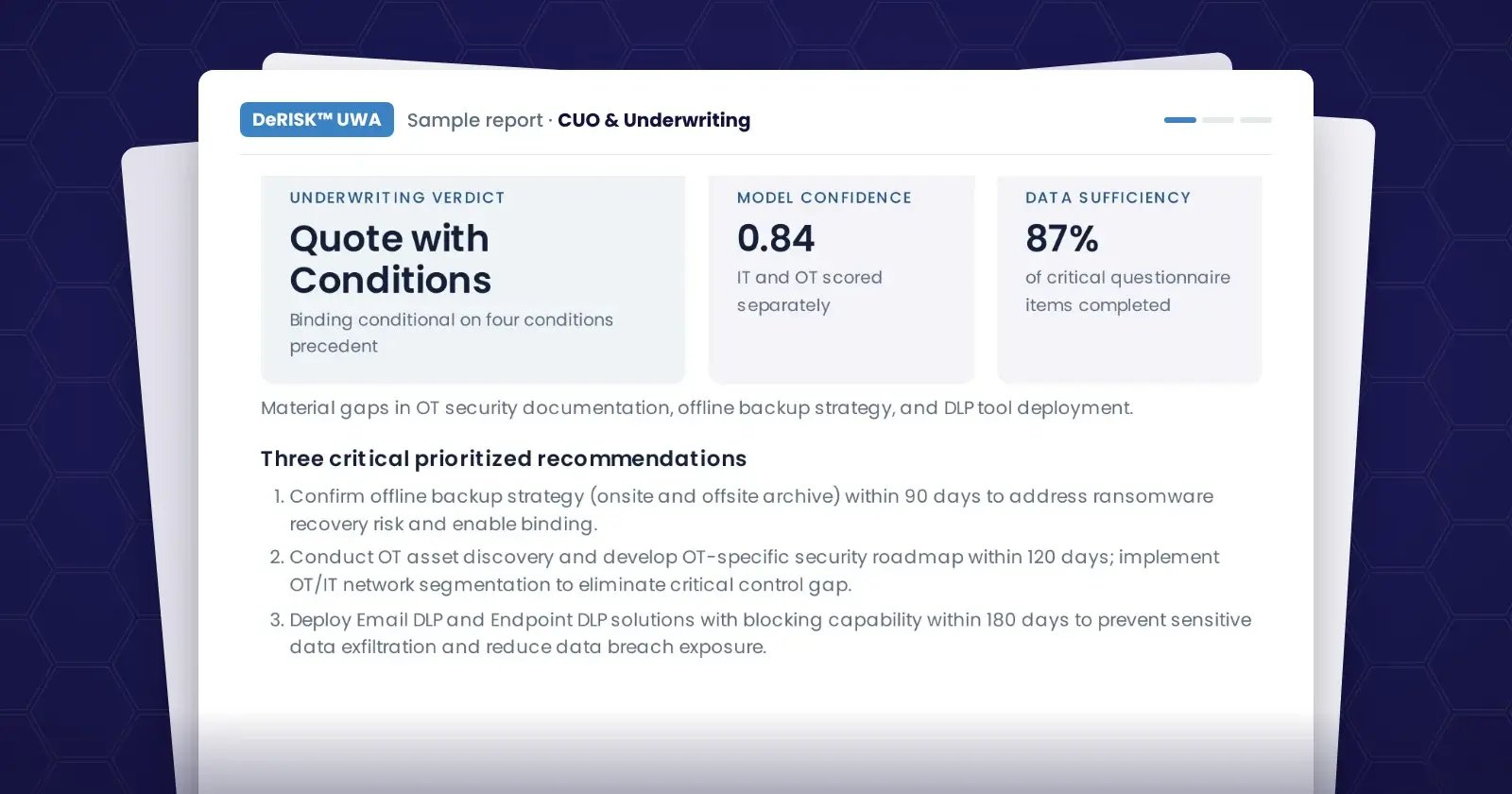
What lands on your desk

Generic views of the committee-ready report on the Professional tier.

Verdict and premium

Confidence

Loss outputs

Key risk indicators

Conditions, in market terms

Evidence trail

Against sector peers

When the broker calls

Answer the broker’s follow-up without reopening the file.

  1. Ask DeRISK in plain words, and Davy answers from this submission’s own results: the verdict, the conditions and the evidence behind each finding.

Your DeRISK results already hold the answer. Finding it shouldn’t take a meeting.

DeRISK Davy add-on

Davy is the voice; the score, the decision and the report come from DeRISK. Davy runs on frontier AI models, privately inside DeNexus’ own cloud environment. Guardrails at the model boundary. No training on your data. Your conversation history stays in your account, and you can delete it at any time.

DavyAnswers from this submission’s results
Broker

Why quote with conditions, not approve?

OT controls are unverified. The OT supplemental wasn’t returned, so OT confidence is 0.20. Three conditions close the gaps.

Ask DeRISK…

A decision you can defend

A human reviews every file

The underwriter decides. Nothing binds without a person.

Every finding traced

A full audit trail and attribution statement.

Your own model, if you prefer

The Enterprise tier substitutes your actuarial model entirely.

Submissions stay private

Each runs in isolation, nothing trains the models, and client data is flushed after the run.

Start free. Scale to committee-ready reports.

Free
Standard
Where you start

You add

  • One submission document, in a pre-trained questionnaire format

You get

  • A short report from the standard actuarial engine, on NIST CSF and IEC 62443-inspired frameworks
Premium
Professional
Most teams

You add

  • Multiple documents and custom submission types

You get

  • Committee-ready reports, white-labeled and saved, on your own insurer framework
  • Add-ons start here
Enterprise
At scale

You add

  • API access and a single-tenant option

You get

  • Your own actuarial model in place of ours, and your own report
Add-ons
From Professional

Choose

  • DeRISK Davy, DeRISK Consultant and DeRISK Scenario Simulator (coming)
Did you know?

Your applicant can send OT evidence, not just answers.

Operators use DeRISK CRQ to put their OT cyber risk in dollars. They can share a Risk Transfer Evidence Bundle based on data-driven telemetry, and DeRISK UWA reads it with the rest of the submission.

  • A modeled loss picture, with attachment and limit anchors
  • The scenarios behind the loss
  • Risk quality from inside data that questionnaires can’t show
  • Improvement since the last renewal

Each document counts toward document coverage, one of the inputs to the confidence score.

ToThe applicant’s broker
SubjectOT evidence for this submission
To help us read the OT side of this risk, could your client share a DeRISK CRQ Risk Transfer Evidence Bundle with the submission? It shows modeled loss, the scenarios behind it and risk quality from inside data.

Featured resources

All learning resources
Sample report page on the cover of the paper Underwriting OT Cyber Risk with Facility-Level DataWhitepaper · 13 min read

Underwriting OT Cyber Risk with Facility-Level Data

A questionnaire tells you what the applicant says. Facility-level evidence tells you what the plant could lose.

Read the paperSample report (PDF)
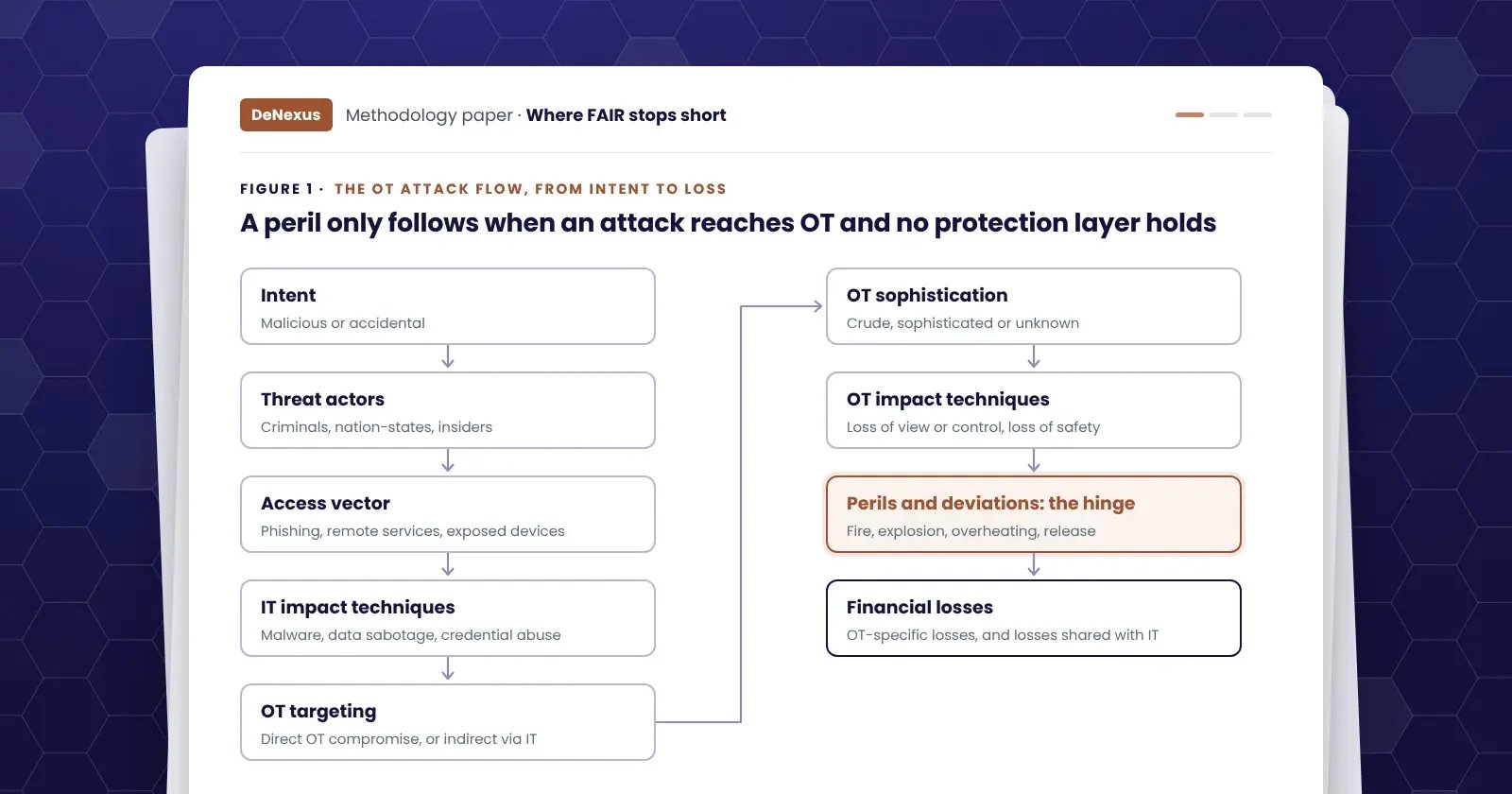
Methodology paper · 20 min read

Quantifying OT Cyber Risk: Where FAIR Stops Short

Read the paper →
Learn article

How certain is a cyber risk quantification result?

Read the article →

See what your next OT submission really says.

Create a free account and run one submission on the Standard tier. It asks the applicant nothing, and you review every output.