In this view
Summary
A questionnaire tells you what the applicant says. Facility-level evidence tells you what the plant could lose, and that is what you can select, price and bind on.
Most cyber questionnaires were written for an office. They ask about IT controls and say little about the plants, so an industrial submission leaves the OT question open (OT is the equipment and software that runs the plant). You close that question with hours, with conditions, or with a decline.
Underwriters, actuaries and reinsurers all charge more when a risk is ambiguous, in the studies that asked them.1 The applicant pays for the doubt, and you carry the risk you could not see.
Three things to take from this paper:
- A "yes" on a form is a statement, not a fact. In one survey of OT practitioners, 28% said their OT was fully isolated from IT, yet 57% said servers could be controlled from the business network.2 A misstated control can void the policy, as one US carrier proved in court.3
- Industrial risk is facility-specific, and when an attack reaches OT the loss changes kind. In DeNexus™'s incident records, about two thirds of the attacks that reached OT ended in irreversible loss, damage no restore or repurchase undoes. Where the attack stayed in IT, about one in twenty did.4 Evidence at the facility level shows which plant you are pricing.
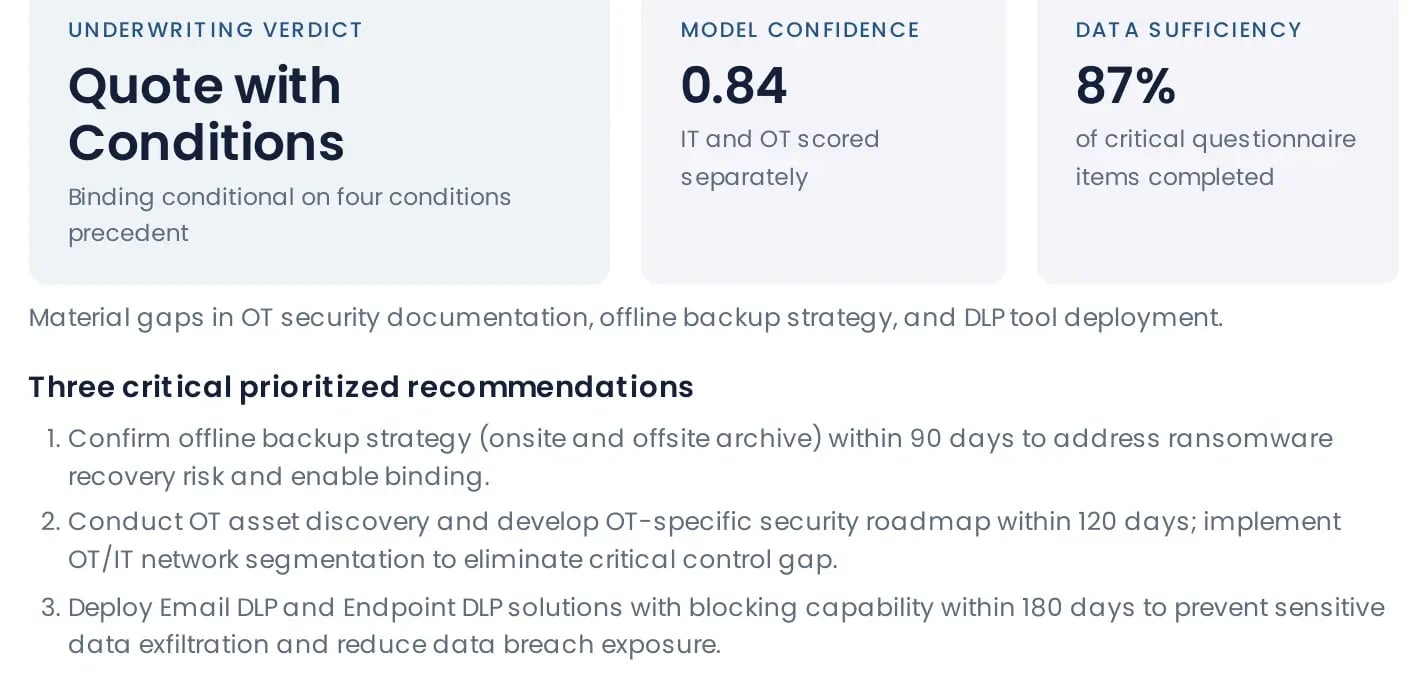
- DeRISK™ UWA reads the submission you already have, asks the applicant nothing, and returns a verdict (approve, quote with conditions or decline), a premium indication and binding conditions. A confidence score separates the controls the applicant stated from the controls the evidence verified. You decide; it does the reading.
Where you sit
You decide which risks to take and on what terms, and you decide fast. Your power is your authority: the classes and line sizes you can bind without referring upward. Those limits are set by the Chief Underwriting Officer, and anything above them goes up the chain. If you underwrite for an MGA or a coverholder, the authority is delegated by a carrier, and the carrier audits your files.5
Everyone around you wants something different. Brokers want speed. Actuaries want rates that hold. Exposure managers cap the aggregate, reinsurers set the exclusions, and claims rarely sends OT lessons back to you.
The market does not help. In Marsh's index, global cyber rates fell 4% in the third quarter of 2026, the 13th quarterly fall in a row, and US cyber rates were flat.6 In a soft market you cannot buy rate adequacy with price. Selection is what is left, and every wrong "yes" lands on the loss ratio.
Regulators now watch the tools you use. The NAIC's model bulletin on insurers' use of AI expects a written AI programme, governance, care in contracting for third-party AI, and documentation a regulator can ask for.7 Nearly 30 US jurisdictions had adopted it by October 2026.8
Six kinds of underwriter read this paper. The line underwriter has the volume and little OT knowledge. The lead underwriter sets terms the market follows, so the terms have to hold. The head of cyber or specialty lines needs consistent decisions across a team that cannot hire OT specialists fast enough.
The Chief Underwriting Officer answers for the loss ratio and to the regulator, so every decision must be explained. The MGA or coverholder underwriter works under a carrier's authority, and the carrier audits every file. The property underwriter knows how bad a fire is, but not how often a cyber attack starts one.
Whichever seat is yours, the refinery on your desk arrives with a form written for an office.
What the form doesn't tell you
A cyber questionnaire describes IT controls. It asks about MFA (multi-factor authentication), backups, endpoint detection and email security. It rarely asks which plants the company runs, what stops if a control system is lost, or how long a restart takes. For an industrial risk, the biggest loss sits in the questions the form never asks.
The market's own research mirrors the form. One broker's 38-page cyber report for 2025 never mentions energy, utilities, factories, OT or control systems.9 In the year before, the same broker quoted a security firm saying insurers had been "effectively mandating" generic controls: MFA and backups.10
The cyber catastrophe models have the same blind spot. One reinsurance broker lists the exposure data fields those models consume, and none of the fields identifies a control system or a plant (DeNexus's reading).11
A stated control is not a verified one. A "yes" to network segmentation cannot be checked without an OT specialist, and most teams have none. In a survey of more than 400 OT practitioners, 28% said their OT was fully isolated from IT, yet 57% said servers could be controlled from the business network.2 Both answers came from people who believed them.
The form also costs you time. On DeNexus's own estimate, a complex industrial submission takes 10 to 30 hours of manual work, and 60 to 80% of that goes to extracting data rather than judging the risk. No third-party study backs those figures, so read them as a vendor's estimate. The pattern is one you live with: the hours go to reading, and the judgement gets what is left.
So the form leaves you three ways to close the OT question. You close it with hours you do not have, with conditions the broker will fight, or with a decline that sends the account to the carrier next door.
The evidence
Each figure in this section names who produced it and when. Vendor surveys are marked as vendor surveys, and DeNexus's own counts are marked as DeNexus's.
The wrong "yes" costs the policy
In 2022, Travelers asked a US court to rescind a manufacturer's cyber policy because the application misstated its use of multi-factor authentication. The court granted the rescission, and the insured agreed to it.3 12 The control in question was one the form asked about. The ones it did not ask about never reached the court.
Stated is not verified
In (CS)²AI's 2024 survey of OT practitioners, 28% said their OT was fully isolated from IT. In the same survey, 57% said servers could be controlled from the business network.2 The two answers may come from different respondents, but the gap is the point. The people filling in your form believe what they write, and the plant disagrees.
What the form says and what the plant does: the same survey, two answers
What arrives outside appetite
In Federato's survey of 500 underwriters and executives, the most common answer put 21 to 30% of the submissions reviewed outside appetite.13 Federato sells underwriting software, so weigh the source. Even at the low end, a fifth of the reading buys nothing.
Which controls move the loss
Dragos and Marsh McLennan built a model on claims data for business interruption and on OT data. It ranks how much five OT controls cut the risk. An incident response plan cuts it by about 18%, a defensible architecture by about 17%, and visibility and monitoring by about 16%. Risk-based vulnerability management cuts it by about 14%, and secure remote access by about 12%.14
Five OT controls and the risk reduction each one buys, on claims data
Modelled by Dragos and Marsh McLennan from Marsh McLennan's business-interruption claims data and Dragos's OT data, mapped to the five SANS critical controls. Not one of the five appears on a standard questionnaire in OT terms.
OT reach changes the kind of loss
DeNexus counted about 40 incident records in its OT Losses research, and where the attack reached OT, about two thirds of the incidents ended in irreversible loss. Where it stayed in IT, about one in twenty did.4 Irreversible means damage no restore or repurchase undoes: equipment destroyed, people hurt or product spilled. The count is DeNexus's own, at medium confidence, and the gap holds under a stricter reading.
When the attack reaches OT, the loss changes kind
What a stop costs, in the units of a claim
Jaguar Land Rover shut its systems down around 1 September 2025 after it found an attack, and car production stopped. Plants restarted in stages from 8 October, and JLR says output was back to normal by mid-November.15 16
JLR reported GBP 196 million of cyber costs in one quarter and GBP 64 million in the next. Together that is about 1.1% of a year's revenue of GBP 22.9 billion.15 16 17 The Cyber Monitoring Centre put the loss across the UK economy at GBP 1.9 billion, with more than 5,000 firms hit.18
Updated 3 November 2026. Expect new information after this date to change this analysis.
Norsk Hydro was hit by ransomware on 19 March 2019 and ran its plants by hand where it could. It paid no ransom and rebuilt from backups. Hydro puts the cost at around NOK 800 million, about 0.5% of its 2019 revenue, and it recognised at least NOK 712 million of insurance compensation across 2019 and 2020.19 20 21 That is a cyber claim paid on a production loss, told to shareholders in money.
Cyber hides in property
About 85% of NotPetya's insured loss came through property policies that never said they covered cyber, by PCS's estimate.22 Since January 2020, Lloyd's has required property policies to either exclude cyber or cover it in plain words.23
The standard clauses do the excluding. LMA5401 removes cyber from property cover outright. LMA5400 gives back fire and explosion only when the cyber incident was not malicious.24 25 So a plant fire that starts with an attack sits between a property policy that says no cyber and a cyber policy that says no property damage.
Both losses were told to shareholders in money, and both were production, not records. That is the risk on your desk, and the form was not written for it.
What it costs you
The cost of pricing from the form lands on you three times: in the hours, in the file, and in the loss ratio.
The cost lands in the hours. The broker wants the quote by Friday, and the OT answers have to be understood by Thursday. On DeNexus's estimate, a complex industrial submission takes 10 to 30 hours of manual work, most of it extracting data rather than judging the risk. The judgement is what you are paid for, and it gets the time that is left.
The cost lands in the file. A decision built on a "yes" you could not check is one you cannot explain. The Chief Underwriting Officer, the carrier's auditor and the regulator who asks how the AI programme is governed will each want that explanation.7 If the "yes" turns out to be wrong, the choice is a rescission fight or a claim paid on a control that was never there.3
The cost lands in the loss ratio. In a soft market, selection is the only lever left, and the form selects on the wrong facts. The industrial risks you decline for want of evidence go to the carrier that can read them.
The pricing side feels it too. In hyperexponential's survey of underwriters and pricing actuaries, 45% of underwriters named inaccurate or out-of-date pricing models as a barrier. Actuaries in the same survey rated their collaboration with underwriters 3.1 out of 5.26 hyperexponential sells pricing software, so weigh the source.
That is the price of underwriting a plant from a form written for an office.
Evidence at the facility level
Facility-level evidence answers a different question from the form. Not "do they have controls?" but "what could this plant lose, and how sure are we?"
It has four parts, per facility:
- The exposure: what the site makes, what stops if its control systems are lost, and for how long.
- The OT controls by layer, verified from documents and data rather than stated on a form.
- The modelled loss: the expected annual loss and the loss in a bad year, with the attack scenarios that drive them. Expected annual loss is how often an incident happens times how bad it is: frequency times severity, or magnitude in FAIR terms.
- A confidence score that says how much of that picture rests on verified evidence, and how much on the applicant's word.
Where the hours go on an industrial submission, on DeNexus's estimate
How often does an incident happen? That question has a known problem. Public evidence on OT losses is thin and actuarial data is limited. Few companies disclose what an incident cost, and fewer still disclose how it happened. Simulation is the practical way through. A model takes what is known about the company (its sector, its facilities, its revenue, its controls, its threat environment) and runs the plausible incident paths many thousands of times to produce a distribution of outcomes: an expected annual loss, and the loss in a bad year, the 1-in-20 or the 1-in-100. The result is a range with its assumptions and data sufficiency stated, and it narrows as better data about the environment comes in. As more OT incidents are disclosed with their financial impact, that evidence calibrates and validates the model. DeNexus quantification is FAIR-based, with its own implementation and OT loss taxonomy, and fills the gaps FAIR and FAIR-MAM leave in OT. The method is set out in the DeNexus methodology paper.28
Three things change once the evidence exists.
First, selection changes. Appetite can follow the exposure at each site rather than the sector label on the slip. A chemicals company with one plant that cannot stop safely is a different risk from one with twelve that can, and the evidence shows which you have.
Second, pricing changes. You already adjust a class rate for the individual risk; the profession calls it individual risk rating.27 Verified controls and a modelled loss give you something to adjust with, instead of a maturity score with no units.
Third, conditions change. A subjectivity tied to a named gap is one the broker can take back to the client, and one the client can meet. For example: secure remote access at one named site, by one named date. A low confidence score tells you to ask for documents before binding, which is a request for evidence, not another question for the applicant.
What DeRISK gives you
Augment your underwriting team with OT cyber specialist capability — without hiring one.
DeRISK UWA reads what already arrived. It is trained on nine insurer and broker questionnaire formats, plus the OT/ICS and ransomware supplementals, and a new format is trained in a day or two. It reads the questionnaire together with the supporting documents, such as asset inventories, policies and prior assessments, and it asks the applicant nothing.
It returns the decision in your terms. A verdict: approve, quote with conditions or decline. The loss outputs: expected annual loss, value at risk, the exceedance curves and the maximum foreseeable loss. An exceedance curve shows how likely a loss above each size is, per occurrence and per year.
The outputs come from a Monte Carlo engine that runs 100,000 simulations and gives the same outputs for the same inputs every time. With them come a premium indication, a programme structure, and binding conditions, each with a deadline.
It tells you what to trust. The confidence score is built from data completeness, document coverage, the OT disclosure rate and the threat-intelligence match. It separates the controls the applicant stated from the controls the evidence verified, and it scores IT and OT separately. A low score prompts a request for documents before binding.
It leaves a file you can defend. Every assessment carries a full audit trail and an attribution statement, and a human reviews every one before it reaches you. It is built for the NAIC, FCA, Lloyd's and EIOPA expectations for AI in underwriting.7 On DeNexus's own figures, submission to assessment takes 10 to 20 minutes instead of 10 to 30 hours of manual work.
It fits where you work: a Microsoft Teams app, Microsoft sign-in and an admin portal, with white-labelled reports from the Professional tier. Each submission runs in isolation. Nothing trains the models, and the client's data is flushed when the run completes.
At the Enterprise tier, your own pricing model replaces DeNexus's engine. For cyber hiding in a property book, DeRISK UWA-CP adds a cyber loading to the property rate.
"AI can't underwrite." Agreed. It binds nothing. A human reviews every assessment, and the underwriter decides.
Read the next refinery submission with an OT specialist beside you. See a sample assessment on the Underwriter page at denexus.ai.
Works Cited
- Kunreuther, Howard, Robin Hogarth, and Jacqueline Meszaros. "Insurer Ambiguity and Market Failure." Journal of Risk and Uncertainty, vol. 7, no. 1, 1993, pp. 71–87, econpapers.repec.org.
- Control System Cyber Security Association International. OT Cybersecurity Technology Report 2024. (CS)²AI, Aug. 2024.
- Travelers Property Casualty Co. of America v. International Control Services, Inc. No. 2:22-cv-02145, US District Court for the Central District of Illinois, 30 Aug. 2022, via dockets.justia.com.
- DeNexus. "Reachability versus Loss Class." OT Losses, unpublished DeNexus research, Sept. 2026.
- Lloyd's. "Welcome to Lloyd's." Delegated Authorities: Coverholders, Lloyd's, updated 8 Oct. 2026, lloyds.com.
- Marsh. "Global Commercial Insurance Rates Fall 5% in Q3 2026; Marks Ninth Consecutive Quarterly Decline." Marsh, 21 Oct. 2026, marsh.com.
- National Association of Insurance Commissioners. "NAIC Members Approve Model Bulletin on Use of AI by Insurers." NAIC Newsroom, 4 Dec. 2023, content.naic.org.
- National Association of Insurance Commissioners. AI Model Bulletin Adoption Map. NAIC, 8 Oct. 2026, content.naic.org.
- Howden. Rebooting Growth: Howden's 2025 Cyber Insurance Report. Howden Group Holdings, 24 Sept. 2025, howdengroupholdings.com.
- Howden. Cyber Insurance: Risk, Resilience and Relevance. Howden Group Holdings, 24 June 2024, howdengroupholdings.com.
- Gallagher Re. Evaluating Cyber Models. Cyber IQ, 3rd ed., Gallagher Re, Nov. 2022.
- Hemenway, Chad. "Travelers, Policyholder Agree to Void Current Cyber Policy." Insurance Journal, 30 Aug. 2022, insurancejournal.com.
- Federato. 2025 State of Underwriting Report. Federato, 2025, federato.ai.
- Dragos and Marsh McLennan. 2025 OT Security Financial Risk Report. Dragos, Aug. 2025, dragos.com.
- Jaguar Land Rover. "JLR Performance Impacted in Challenging Quarter." JLR Media Newsroom, 14 Nov. 2025, media.jlr.com.
- Jaguar Land Rover. "JLR Q3 Performance Impacted by Previously Indicated Challenges." JLR Media Newsroom, 5 Feb. 2026, media.jlr.com.
- Jaguar Land Rover. "JLR Delivers Significantly Improved Q4 Performance in Challenging Year." JLR Media Newsroom, 14 May 2026, media.jlr.com.
- Cyber Monitoring Centre. "Cyber Monitoring Centre Statement on the Jaguar Land Rover Cyber Incident." Cyber Monitoring Centre, 22 Oct. 2025, cybermonitoringcentre.com.
- Norsk Hydro ASA. "Cyber-Attack on Hydro." Hydro, updated 15 May 2024, hydro.com.
- Norsk Hydro ASA. Financial Statements and Board of Directors' Report 2019. Hydro, 2020, hydro.com.
- Norsk Hydro ASA. Financial Statements and Board of Directors' Report 2020. Hydro, 2021, hydro.com.
- PCS (Property Claim Services). "Could NotPetya's Tail Be Growing?" PCS Global Cyber, Verisk, July 2019, verisk.com.
- Dunn, Caroline. "Providing Clarity for Lloyd's Customers on Coverage for Cyber Exposures." Market Bulletin Y5258, Lloyd's, 4 July 2019, assets.lloyds.com.
- Davison, Patrick. "Property and Marine Cyber Clauses." Bulletin LMA19-031-PD, Lloyd's Market Association, 13 Nov. 2019, lmalloyds.com.
- BMS Group. London Market Cyber Exclusions. BMS Group, Sept. 2020, bmsgroup.com.
- hyperexponential. 2025 State of Pricing. hyperexponential, Nov. 2025, as reported in "Underwriter, Actuary Fears of AI Drop; Work Needed on Collaboration," Insurance Journal, 24 Dec. 2025, insurancejournal.com.
- Sherwood, Margaret Tiller. "Individual Risk Rating." Foundations of Casualty Actuarial Science, 4th ed., Casualty Actuarial Society, 2001, pp. 159–196, casact.org.
- DeNexus. Quantifying OT Cyber Risk: Where FAIR Stops Short. DeNexus methodology paper, 2026, denexus.ai.